

 PRINT THIS PAGE
 When you go for swimming or think about swimming pool €¦. These are the Check Points:
» What is the filtration turnover time with respect to pool volume & depth?
» What is the swimming pool filtration technique, duration of filtration & backwash frequency?
» Clarity of pool water & odor (freshness) from pool?
» What is the permitted bather load per session with respect to pool surface area?
» Is Chlorine & Chlorine derivatives used for pool water disinfection?
» What is the Chlorine dose & free residual chlorine in the pool?
» Ozonation used for swimming pool water treatment?
» Importantly Which standard/Guideline is followed for swimming pool water treatment.
Swimming Pool Water Treatment
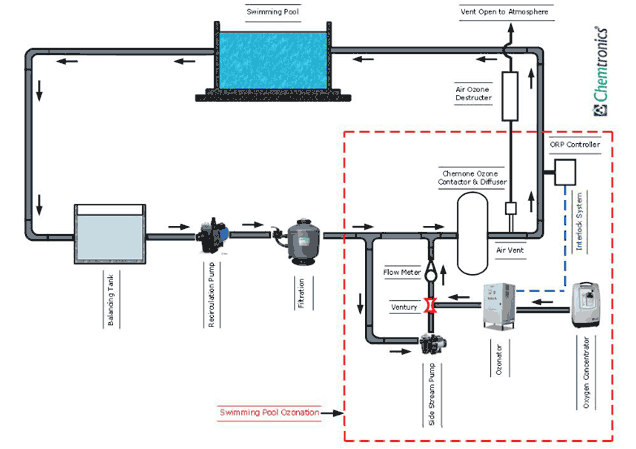
Depending on the above points following operations may be part of the overall treatment system. Swimming pools shall be equipped with a recirculation system which, at a minimum, consists of a pump, a filter, connecting piping, fittings, valves, disinfecting equipment, necessary pipe connections to the inlets and outlets.
1. Flow rate & Turnaround Time: -
Pool becomes polluted at different rates. Generally the shallower the water the more bathers per cubic meter and an open air pool has greater surface pollution than an indoor one. The filters on a swimming pool must be adequate to handle the required turnover rate or volume of water necessary to maintain clear, clean and attractive water. Recommended turnaround time for public pool is 4.0 hrs as per International standard/guidelines.
2. Recirculation Pump :-
Recirculation pump pulls water from the pool and pushes it through the filter or it pulls the water through the filter and pushes it back to the pool. Must be capable of pumping enough water through the system to provide the required number of turnaround.
3. Pre -Filtration System : -
Filtration is the heart of the circulation system. Recirculation system shall include a pre-filtration system (like basket strainer or bar screen to prevent hair, lint and foreign objects from reaching the pump and filters. This will prevent such physical impurities choking filtration mechanism and increasing pressure on pump which may cause breakdown demanding maintenance. This will cause interruption to facility/service to users & cost to operation.
The main purpose of the filter is to remove particulate matter and debris from the pool water. It strains out suspended solids down to sub-micron- size particles in order to maintain water clarity. There are different options available for swimming pool filtration system.
4. pH Control :
Feeders for pH adjustment are provided on pool. pH adjustment feeders shall be positive & negative displacement type, and are adjustable from zero to full range. It has an electrical interlock with the circulation pump to prevent discharge when the recirculation pump is not operating.
5. Swimming Pool Water Disinfection & Oxidation
Water disinfection is one of the key treatment steps for all types of swimming pools, whether public or private. Efficient water disinfection is essential for pools. In order to ensure safe bathing water, most public facilities must follow strict water disinfection standards and practices.
A proper balance of the water chemistry factors will provide water that will not damage pool components and is non-irritating to swimmers. It is then necessary to provide for disinfection of the water to prevent the spread of disease organisms from person to person and prevent unwanted growth of bacteria and algae in the pool.
Sanitation: - After filtration and pH correction the microorganism must be killed or inactivated. The most common practice choice for sanitation is chlorine, UV-light and ozone treatments are effective sanitizers.
Oxidation: - Organic contaminants not captured by the filter must be eliminated before they react to form DBPs (Disinfection Byproducts). Chlorine, ozone and UV all work to varying degrees to break down chemicals and some recirculated DBPs in pool water.
The pool water treatment objectives are to:
1. Keep the water free from pathogenic (harmful) bacteria.
2. Keep the water free from growth of algae.
3. Ensure the water is neither toxic nor irritating to swimmers.
4. Prevent the formation of undesirable smells or taste in the water.
5. Prevent corrosion of the pool surround.
6. Prevent scale formation in the pool.